










More about: The 10 Most Famous Cemeteries in Paris
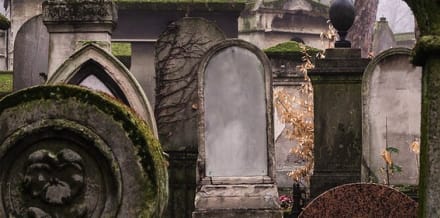
Cemetery tourism attracts millions of visitors worldwide. The French capital is also famous for its graveyards, so much so that National Geographic has included two of them in its list of the world’s 12 best.
The cemeteries selected are the famous Père Lachaise and Montmartre, but there is much more to discover. If you’re looking for things to see and do in Paris, this article will help you plan your holiday.
1. Père Lachaise Cemetery

Probably the most famous cemetery in the world. Its construction was a consequence of the Edict of Saint-Cloud, a decree that required the burial of the dead outside the city walls. Indeed, in the early 19th century, this peaceful graveyard was situated a few kilometres from the city centre.
Year after year – and not without a few difficulties – the cemetery has come to house both famous figures and ordinary people. The most famous grave is that of Jim Morrison, who died in Paris in 1971. However, it is not the only one worth seeing:
- Fryderyk Chopin, the Polish musician (with the exception of his heart, which lies in Warsaw), rests at Père Lachaise. The sculpture of a weeping muse watches over the site
- Georges Rodenbach, a Belgian poet and novelist who settled in the French capital. His tomb depicts Rodenbach himself emerging from a large block of granite
- Oscar Wilde: the mausoleum was designed by Jacob Epstein and depicts a winged figure, likely inspired by the poem ‘The Sphinx Without a Secret’.
To discover the other graves, it’s worth booking a guided tour with an expert who will take you around for just over two hours and explain each of the site’s secrets.
After a good stroll through the cemetery, it’s normal to feel a bit peckish. In that case, I recommend booking a table at Bistrot Père (10 Avenue du Père Lachaise).
- Price: between €30 and €60
- How to get there: the nearest metro stations are Gambetta (lines 3 and 3B), Père Lachaise (lines 2 and 3) and Philippe Auguste (line 2)
2. Montparnasse Cemetery

Montparnasse is one of the best neighbourhoods in Paris. It was once the epicentre of artistic life and is now highly recommended both for accommodation and for going out.
There are dozens of charming bars and restaurants such as Le Barbylone (famous for its craft beers) and Hardware Société (a mecca for brunch lovers).
However, most tourists come here to visit the cemetery of the same name. Opened in 1824, it is a veritable open-air museum, as many of the graves have been listed as Historic Monuments.
It stretches from Montparnasse railway station to Place Denfert-Rochereau and is divided into two parts: the Petit-Cimetière and the Grand-Cimetière. The most famous graves are those of Charles Baudelaire, André Citroën, Jean-Paul Sartre and Samuel Beckett, though the list could go on.
- Price: admission is free
- How to get there: the cemetery is surrounded by the metro stations of Raspail (lines 4 and 6), Edgar Quinet (line 6), Denfert-Rochereau (lines 4 and 6) and Gaîté (line 13)
If you’re into the macabre and want to spend a spooky night in Paris, don’t miss the night-time ghost tour, where you’ll hear all the most gruesome legends and stories hidden in its streets.
3. Passy Cemetery

This tiny cemetery is home to the graves of 19th-century aristocrats, industrialists and artists. A stroll through the grounds will give you the chance to admire the silhouette of the Eiffel Tower and the graves of Marcel Renault (racing driver and founder of the eponymous company), the musician Claude Debussy, the Impressionist painter Édouard Manet and Bảo Đại, the last emperor of Vietnam.
To enter, you’ll need to pass through the monumental entrance gate and the reception pavilion (pavillon d’accueil) designed by architect René Berger in the early 1930s. If you’d like to plan your route in advance, you can download the map from the official website.
- Price: admission is free
- How to get there: the cemetery is located near the Trocadéro Gardens, directly opposite the Eiffel Tower in Paris. The nearest metro station is Trocadéro (lines 6 and 9)
4. Montmartre Cemetery
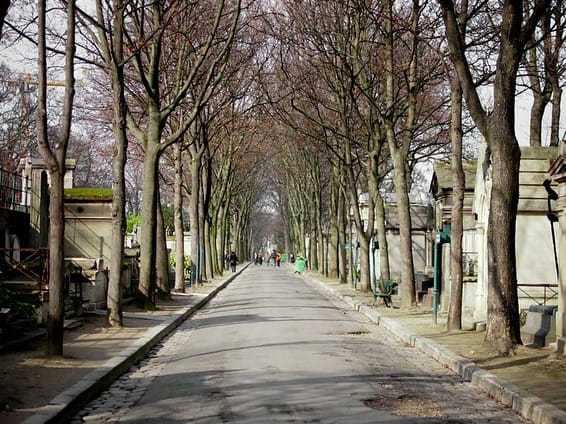
No stay in Paris can be considered complete without a stroll through Montmartre. When the French capital was the art capital of the world, artists of the calibre of Degas, Van Gogh and Picasso used to stroll here. Its most visited monument is the Basilica of the Sacred Heart (Sacré-Cœur), closely followed by the neighbourhood’s cemetery.
Like its cousin, the Père-Lachaise Cemetery, it is known for being a romantic oasis within the city. Its most famous graves are those of the film director François Truffaut, the writer Alexandre Dumas and the Impressionist painter Edgar Degas.
Thanks to its cobbled streets and historic cafés, Montmartre is the quintessential romantic destination. To find out about all the things to do, I recommend reading the article explaining what to see and do in Montmartre.
- Price: free
- How to get there: the nearest metro stations are La Fourche (line 13), Blanche (line 2) and Place de Clichy (lines 2 and 13)
5. Picpus Cemetery

Although it is not among the most famous cemeteries, it is certainly worth a visit. Its origins are linked to the French Revolution and the subsequent Reign of Terror. It is estimated that between 16,000 and 40,000 people were executed, whose remains ended up in the Picpus cemetery.
Today it is a private cemetery and only the descendants of the victims of the Reign of Terror may be buried here. The most visited grave is that of the Marquis de La Fayette, a military man, politician and staunch defender of democratic principles.
He played a crucial role in the founding of the United States and his grave is a destination for many American tourists.
If you decide to venture away from the city centre to visit this part of Paris, you can take the opportunity to see the monumental Place de la Nation, admire the trompe-l’œil ‘Fresque La Serre’ (Rue de Reuilly) or play a game of pool at the famous Billard Nation Shoot Again (Cité Debergue 9).
- Price: entry to the cemetery costs around €2
- How to get there: the cemetery is located near the Bel-Air and Picpus metro stations, both on line 6
6. Batignolles Cemetery

Although it is the final resting place of André Breton and Paul Verlaine, it is not very well known and few tourists make their way here. The cemetery borders one of the city’s noisiest and busiest ring roads, the Boulevard Périphérique, but not even this thoroughfare can rob it of its charm.
Until the 1970s, it was the burial ground for the Russian community in the French capital. For this reason, in a corner of the cemetery lies the grave of Léon Bakst, the painter and set designer who created splendid costumes for the Opéra Garnier in Paris.
- Price: free
- How to get there: the entrance is a short walk from Porte de Clichy, a station on metro lines 13 and 14 and on the RER C line
7. The Panthéon and its crypt

A neoclassical building designed by the architect Jacques-Germain Soufflot. When commissioned by the ‘Sun King’, the monarch asked him to design a grand church dedicated to the patron saint of Paris: Saint Genevieve. Its high dome and portico of Corinthian columns betray its original purpose.
Everything changed after the French Revolution. With the change of regime, this grand temple became the burial place of France’s most celebrated figures. Here lie the remains of Émile Zola, Voltaire, Marie Curie and other important figures.
By the way, if you’d like to learn more about this historical period, you can visit the Musée Carnavalet, which houses a collection of objects used during the revolutionary era (23 Rue de Sévigné).
- Price: a standard ticket costs around €11. If you wish to include the climb to the viewing point, you’ll need to pay around €15
- How to get there: the most convenient metro stop is Cardinal Lemoine (line 10)
8. Catacombs of Paris

In the 18th century, there was no space left in Paris to bury the dead. To deal with the crisis, the authorities decided to move the bones from the mass graves to the underground quarries hidden between the banks of the Seine and the city centre.
The first tours took place in the late 19th century and, more than 100 years later, they continue to attract tourists. Before descending into the bowels of the capital, a sign warns: “Arrête! C'est ici l'empire de la mort” (Stop! This is the realm of death). The tours are very evocative and last between one and two hours.
The meeting point for the tours is usually Avenue du Colonel Henri Rol-Tanguy. For more information, I recommend reading the article on tours of the Paris Catacombs.
- Price: between €30 and €80
- How to get there: the nearest metro station is Denfert-Rochereau (lines 4 and 6)
9. Napoleon’s tomb at Les Invalides

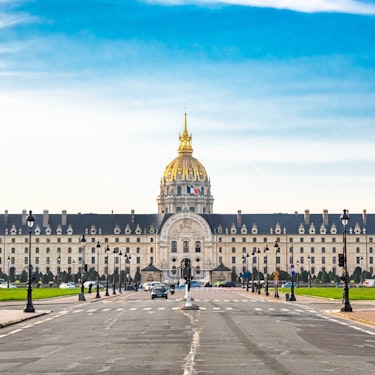
After commissioning the construction of the monumental Palace of Versailles, Louis XIV of France, nicknamed the ‘Sun King’, ordered the building of the Hôtel des Invalides. Initially, this structure provided accommodation and medical care for soldiers wounded in battle.
It is not a true cemetery, yet it houses the remains of the most famous Frenchman in the world: Napoleon Bonaparte. Twenty-one years after his death, the emperor returned to Paris for the last time and has since rested in a large red quartzite sarcophagus.
In addition to the tomb, the building houses the Army Museum and the Museum of Relief Maps. To learn more, I recommend reading the post on visits to the Hôtel des Invalides and Napoleon’s tomb.
- Price: an adult ticket costs around €15. EU citizens under 25 enter free of charge
- How to get there: the nearest metro station is Invalides (lines 8 and 13)
10. Tomb of the Unknown Soldier

During the First World War, France lost one and a half million men. These soldiers died in the gruelling trench warfare that mainly took place on the Eastern Front against Germany. After the conflict, the authorities decided to erect a monument beneath the Arc de Triomphe.
The Tomb of the Unknown Soldier is a tribute to an anonymous French soldier who died in the terrible Battle of Verdun. An eternal flame pays tribute to the nameless victims of all wars.
- Price: free
- How to get there: the nearest metro stations are Kléber (line 6) and Argentine (line 1)
Can you visit at night?

I’m afraid cemeteries don’t usually open after sunset. If you’d like to do something like this, you could opt for a night-time cruise on the Seine, a walking tour of the old town, or a trip around Montmartre in a Citroën 2CV.
Other popular options include private Segway, bike or hop-on/hop-off bus tours. For more information, I recommend reading the article that explains everything you need to know about visiting Paris at night.