










More about: 10 Best Gaudi Buildings in Barcelona
If there’s one thing you simply can’t miss when planning what to see and do in Barcelona, it’s Gaudí’s works. The brilliant architect left his mark on much of the city, and there’s no doubt that visiting his finest creations is an absolute must on any trip to the Catalan capital.
La Pedrera and Park Güell are just two of the many works created by the architect from Reus. The Catalan capital is home to a large number of his works, and our article reveals the top ten. The first is located just a few metres from Las Ramblas, Barcelona’s most famous street
1. Street lamps in Plaça Reial

When Gaudí was working on the Parc de la Ciutadela – not as the lead architect but as an assistant – the city council took notice of him. This talented young man deserved an opportunity, which materialised with the commission to design the street lighting for two urban squares: Plaça Reial and Pla del Palau. Today, only the original street lamps remain, interspersed amongst the fountain and the palm trees.
The street lamps are characterised by features such as the iron medallion with floral motifs and the coat of arms of Barcelona. The square is located in the Gothic Quarter and is home to two of the city’s legendary concert venues: Sidecar and Jamboree.
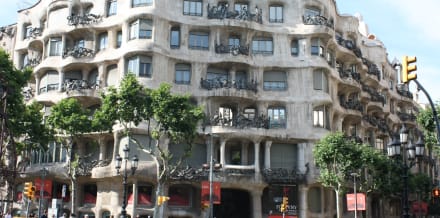
2. Casa Milà (La Pedrera)

It was the last residential building constructed by Gaudí. The client was Pere Milà, a young and successful businessman with a passion for innovation. He was the first to drive a car in Barcelona and deserves a chapter of his own. Upon completion of the building, he and his wife Roser Segimon moved into the main flat and rented out the rest.
The rough-hewn limestone façade was built using rocks from the Garraf Massif and Vilafranca del Penedès, both south of Barcelona. Gaudí shaped them as if they were a cliff face and added the ‘chimeneas espanta bruixes’ (witch-scaring chimneys), balconies with wrought-iron decorations and other artistic details. From the outside, you can see the main entrance sheltered by a large iron gate.
The interior is just as impressive. The Pedrera Apartment on the fourth floor houses a permanent exhibition recreating the home of a Barcelona family from the early 20th century. I recommend booking tickets in advance; it’s a very popular attraction and it’s best to avoid queues or potential disappointment.
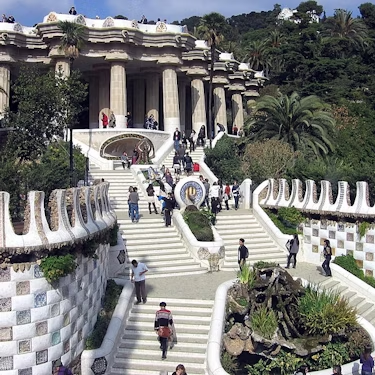
3. Park Güell
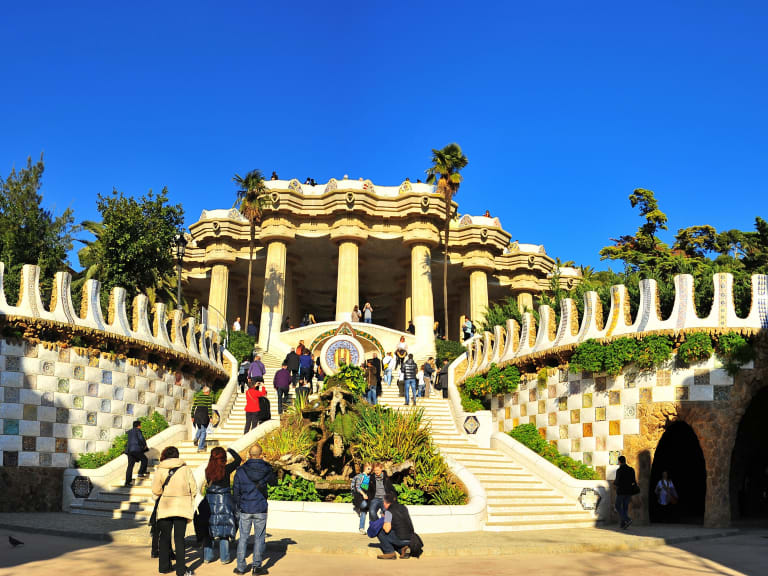
The highest part of the Gràcia neighbourhood is home to one of Barcelona’s treasures: Park Güell. Few cities can boast such an evocative green space. Paths, trencadís sculptures, colonnades and other details typical of the architect from Reus are enveloped in vegetation, a feature that is particularly appreciated in summer. This urban space owes its origins to the wealthy businessman Eusebi Güell, a name you’ll come across again throughout this post.
From its viewpoint, you can enjoy one of the best views of the city. It’s a classic image of the city: the picturesque Casa del Guarda in the foreground, with the capital’s skyline and the Mediterranean in the background.
As it is situated on a hill, the streets are quite steep. Fortunately, escalators connect the Baixada de la Glòria (near Vallcarca metro station, line 3) and Avinguda del Santuari de Sant Josep de la Muntanya, a street just a few metres from the entrance.
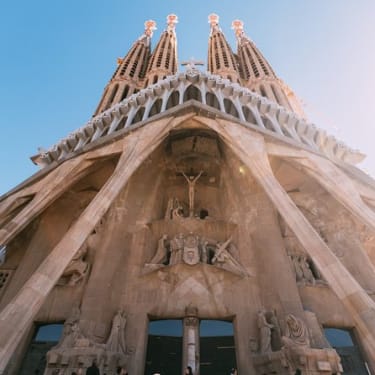
4. Sagrada Familia

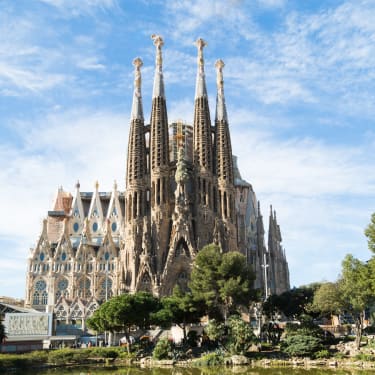
It is the icon of Barcelona and the city’s most visited monument. Gaudí began work on the building in 1883 and never lived to see its completion. In fact, the basilica is still under construction and, when finished, will be the tallest in the world.
You may not know that Gaudí took over from the architect Francisco de Paula del Villar, who had been commissioned a few years earlier. His design envisaged a more classical-style neo-Gothic church.
From the outside, the most striking features are the towers decorated with scenes from the Nativity, the Passion, the Death and the Resurrection. Two of these towers – the Tower of the Passion and the Tower of the Nativity – have lifts that take you up to the viewing platform. From here , you can enjoy a wonderful view over the city, the coast and the Collserrola hills.
If you’d like to discover what lies within, I recommend reading the dedicated article.
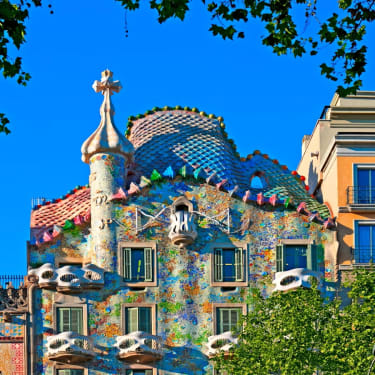
5. Casa Batlló
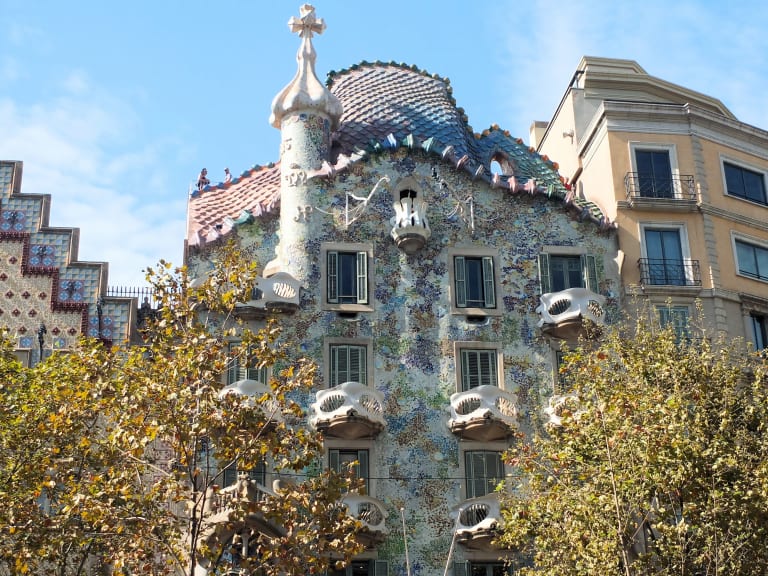
No one can remain indifferent to its façade. When Gaudí was commissioned by Josep Batlló y Casanovas, he was able to give free rein to his imagination. It is a striking residence which, according to the most widely accepted theory, pays homage to the legend of Sant Jordi (Saint George). If you look up, you’ll see a roof decorated with blue, green and reddish tiles; when the sun shines on it, it looks even more like a dragon.
Booking a ticket will give you the chance to explore the interior. The first space you’ll see is the entrance hall, a welcoming area evoking the marine world. Another magical spot is the Courtyard of Light with its tiles in various shades of blue. At Casa Batlló, every detail has been meticulously crafted, from the Main Floor to the attic. To decorate the rooms, Gaudí enlisted the finest craftsmen of the era, and the result will take your breath away.
It is located at number 43 Passeig de Gràcia, a short distance from other Modernist marvels. Next to it stands the extravagant Casa Amatller by Josep Puig i Cadafalch. The avenue is also home to the famous Pedrera.
6. Güell Pavilions
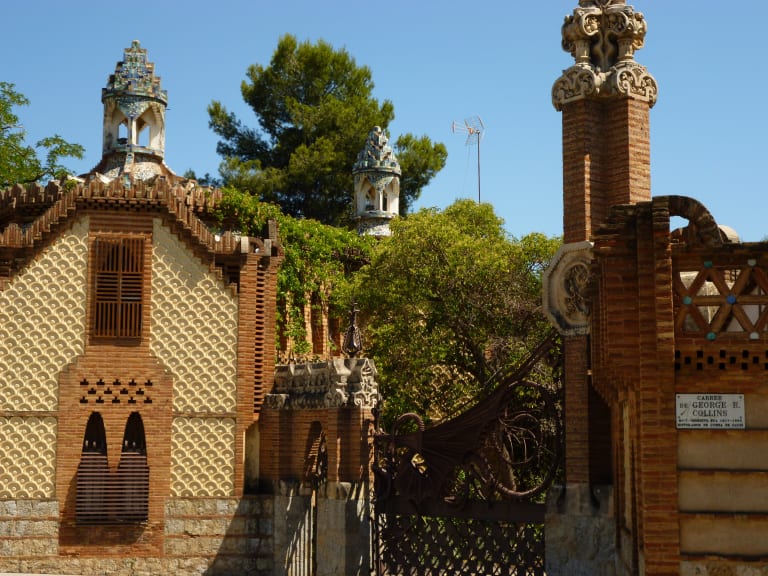
These are the gardens of the summer palace of the businessman Eusebi Güell. They are situated next to the Royal Palace of Pedralbes and about a fifteen-minute walk from the Spotify Camp Nou. At the main entrance, the spectacular wrought-iron gate stands out, depicting the myth of Ladon, a dragon who was defeated by Hercules.
7. Bellesguard Tower

This work by Gaudí is the perfect excuse to visit Sarrià – Sant Gervasi, a residential district that lies off the beaten track. However, it is well worth taking a stroll through its streets; in addition to the Bellesguard Tower, it boasts elegant squares, the Modernist residences on Tibidabo and Foix avenues, and one of the city’s finest patisseries.
Let’s get back to the main topic: the Torre Bellesguard is a neo-medieval building standing on the foundations of an ancient castle.
Gaudí restored the original structure, rebuilt the outer walls and added details typical of his creativity, such as the four-pointed spire that adorns the watchtower, the slate cladding and the trencadís – mosaics made from irregular fragments of ceramic and joined with mortar.
On some weekends, at the foot of this magnificent building, ‘Bcn en las alturas’ is held, a market dedicated to fashion, interior design, art and gastronomy. Tickets cost around €5, whilst opening hours are from 11:00 to 22:30 (Friday, Saturday and Sunday).
8. Palau Güell
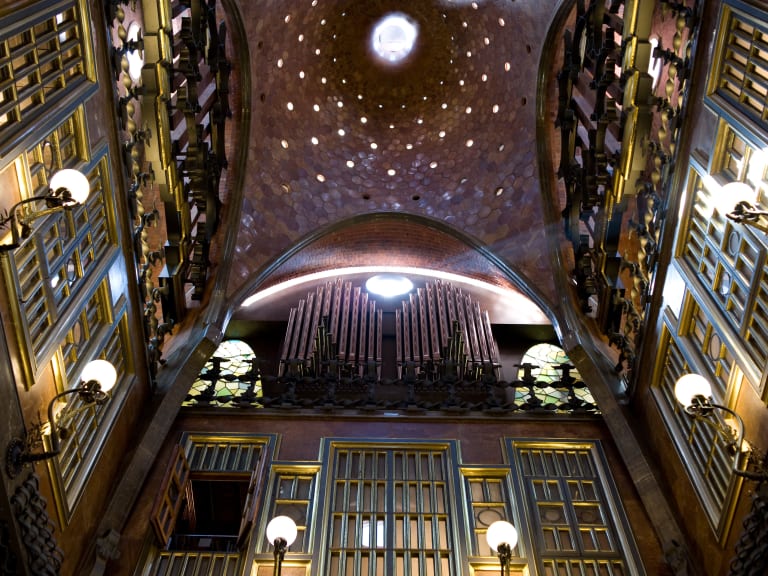
Just a few metres from Las Ramblas lies a hidden gem of Modernism: Palau Güell. It was completed in 1890 and represents the zenith of Gaudí’s early career.
The architect took the opportunity to experiment with new solutions and adopt the features that would later make him famous. For example, 20 chimneys protrude from the building, all decorated with the characteristic trencadís.
Palau Güell is the only building that Gaudí was able to complete, quite an achievement when one considers the genesis of the Sagrada Familia. The genius from Reus adapted the residence to its surroundings; as it is situated in a narrow street in the Raval district, the exterior is not particularly ostentatious, whilst the interior stands out for its elegance and magnificence.
It is located at Carrer Nou de la Rambla 3/5 and is open from 10:00 to 20:00 (April to October) and from 10:00 to 17:30 (November to March).
9. Casa Vicens
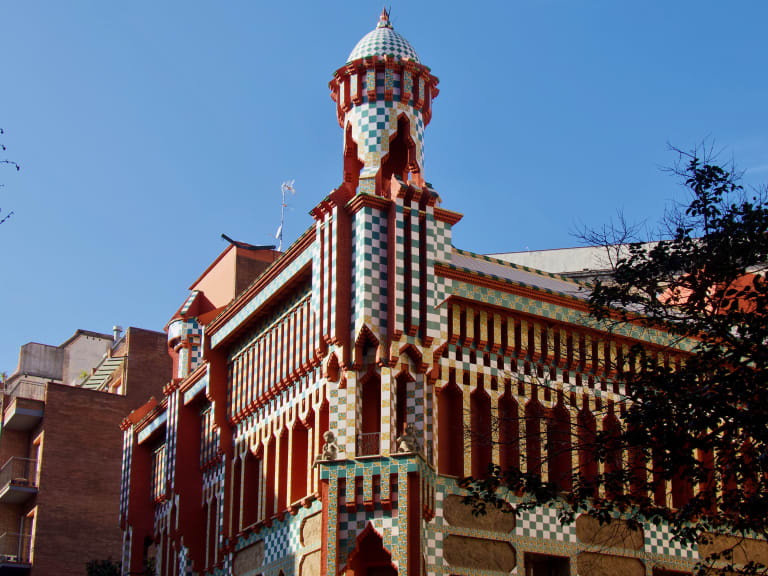
A Modernist mansion in the heart of Gràcia. It was the first major work by the architect from Reus, who built it in the late 19th century on commission from Manuel Vicens i Montaner.
Gaudí drew inspiration from nature and designed a residence decorated with flowers and botanical motifs. Since 2017, Casa Vicens has been a house museum. A visit in spring is particularly recommended as it is surrounded by a beautiful garden.
10. Santa Teresa Ganduxer School

From a distance, this school in the Sarriá – Sant Gervasi neighbourhood looks like a building halfway between a Moroccan kasbah and a Gothic mansion. Perhaps it’s the palm trees in the garden or the reddish bricks that make up its austere façade; what’s certain is that it has an exotic yet fascinating appearance.
Gaudí designed this building to house a school and the residence of the Order of Saint Teresa. Unfortunately, it cannot be visited as it is still a school.
Are there any other works by Gaudí in Barcelona?

Of course! The list above merely highlights the best ones. One of the most traditional yet often overlooked works is Casa Calvet. It was commissioned by the textile entrepreneur of the same name, who wanted a new headquarters for his business as well as a family residence. Its façade may appear classical, yet it features typical Art Nouveau elements.
Today, the ground floor houses China Crown, a restaurant specialising in imperial Chinese cuisine.
Other highlights include the Fountain of Hercules (which remained unknown until 1984; it is located in the gardens of Pedralbes Palace), the mosaic in the Church of Sant Pacià (in the Sant Andreu district) and the Portal Miralles, a monumental entrance in the Sarriá neighbourhood.
Are there any works by Gaudí in the area around Barcelona?

Of course there are! He was a very famous architect and his works are not limited to Barcelona. If you’re planning to stay in Barcelona for more than three days, you can take the opportunity to explore the surrounding area. The following list brings together the destinations bearing the signature of the Catalan genius:
- Colonia Güell, a complex comprising a textile factory, workers’ housing, a school, the doctor’s house and a church known as the Gaudí Crypt. It is located in Santa Coloma de Cervelló, a town a short distance from Barcelona. Eusebi Güell decided to relocate the company here to prevent the spread of trade union ideas that were causing numerous strikes in Barcelona. You can get there on metro line 8. Get off at the Molí Nou – Ciutat Cooperativa stop and walk for a few minutes
- Artigas Gardens. This destination will take you to La Pobla de Lillet, a town surrounded by mountains. In the green area, the River Llobregat winds its way through the bridges and footpaths designed by the architect from Reus. To get there, you’ll need to take an Alsa bus or hire a car
- Nau Gaudí, the architect’s first project. In the late 19th century, the businessman Salvador Pagés commissioned him to build the industrial complex for the Sociedad Cooperativa Obrera Mataronense. Only two buildings have survived the passage of time: the cotton bleaching shed and the latrine block
If you’re travelling in summer, you might fancy visiting an architectural gem on the Costa Dorada. Between Sitges and Castelldefels stand the Güell Wineries, one of the many works commissioned by the businessman of the same name.
From the outside, this stone building resembles a medieval castle. Its distinctive feature is the stone roof; it is not simply a roof but a wall that envelops the cellars. It currently houses a restaurant.